The challenge
Your boomilever has one job: hold 15 kg of sand with the chain 40 to 45 cm out from a wall, using as little wood as possible. This lab walks you through the loop that gets you there. Design it, build it precisely, test it until it breaks, write down what happened, and make the next one lighter.
- Design
- Build
- Test
- Learn and optimize
New this season? Read the 2027 overview first: what changed from 2026 and how it shapes the design.
 Watch the setup
2027 Boomilever Event Supervisor Guide
How the event is set up and run, the way you'll see it on competition day.
Watch the setup
2027 Boomilever Event Supervisor Guide
How the event is set up and run, the way you'll see it on competition day.
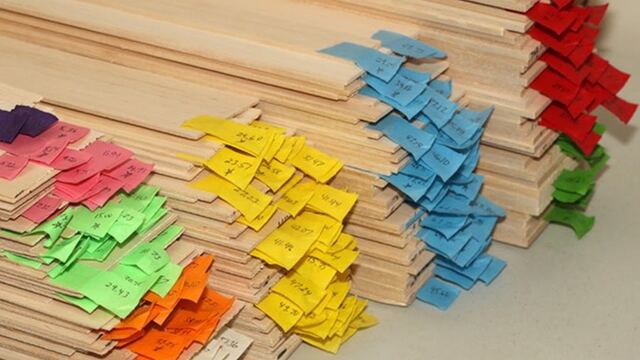 More videos
Balsa Engineering
Videos on the rules, building, and optimizing.
More videos
Balsa Engineering
Videos on the rules, building, and optimizing.
How you score
The score rewards efficiency: how much load you hold for every gram of wood.
To earn the 5,000 g Load Scored Bonus, the structure must touch the wall only above the 15 cm line and hold the full 15 kg (rule 3.i). Two things follow from that:
- Nothing counts past 15 kg. Any wood that lets your boomilever hold 20 kg is wasted mass. The target is a structure that holds 15 kg every time, with a small margin, and no more.
- Failing the bonus is not a penalty. If a bonus-geometry structure breaks at 13 kg, it is scored as 13,000 g ÷ mass, with no construction violation.
- Base still counts. If it touches the wall below the 15 cm line but above the 20 cm line, it is scored as a Base structure.
Bonus or base: is it worth it?
Moving the wall contact up from the 20 cm line to the 15 cm line makes the main tension and compression forces bigger (you will see why on sheet D-2), so a bonus design usually needs more wood. The bonus adds 5,000 g to 15,000 g, a 33% boost. So the bonus design wins only if it is less than 33% heavier than the base design that holds the same 15 kg.